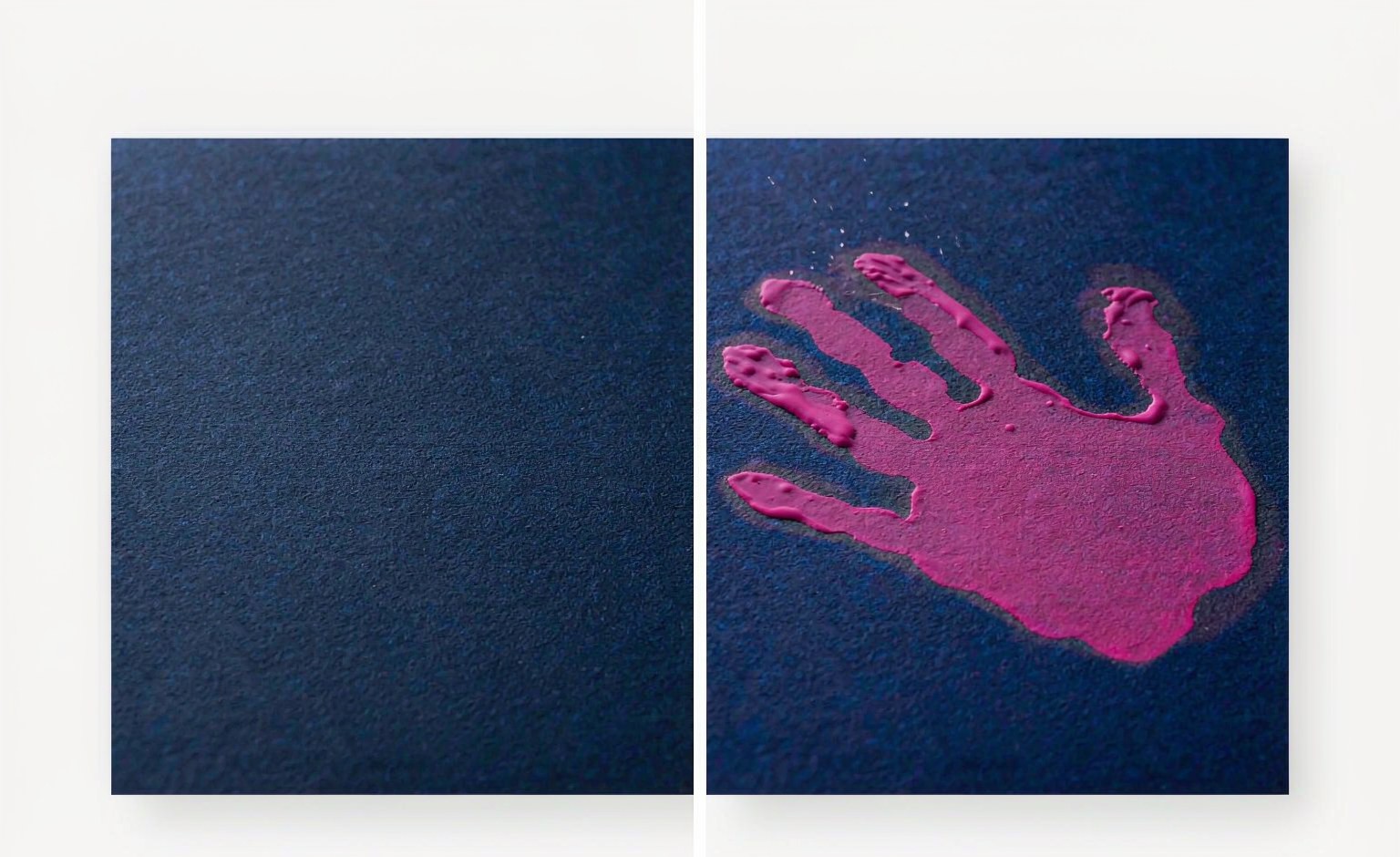
Thermochromic pigment changes colour with temperature. Unlike photochromic, the trigger is heat, which makes it ideal for "mood" drinkware, baby-feeding cues and interactive packaging.
The active chemistry — a leuco dye, a colour developer and a solvent — is locked inside tiny microcapsules. Below the activation temperature the dye and developer associate to show colour; above it the solvent melts, the association breaks, and the colour disappears (or shifts). The capsules protect the chemistry from the carrier.
| Parameter | Typical options |
|---|---|
| Activation temperature | Common 31 °C "mood" grade; also lower/higher grades |
| Direction | Reversible (returns on cooling) vs irreversible (one-way) |
| Hysteresis | The heat/cool switch points differ slightly — design around it |
| Base colour | Colourless→colour, or colour→colour |
Microcapsules are mechanically fragile and water-sensitive in some systems; they suit solvent/UV-cure and many coating bases but need protection in aqueous or high-shear processes. A clear topcoat preserves the effect.
Q: Can I set a custom activation temperature?A: Within a range, yes — grades are offered at several fixed activation points. True arbitrary temperatures are not practical; choose the nearest commercial grade.
Q: Why does my sample switch at different points heating vs cooling?A: That is hysteresis, an inherent property of the leuco-dye system. Build your design tolerance around it rather than expecting a single sharp threshold.