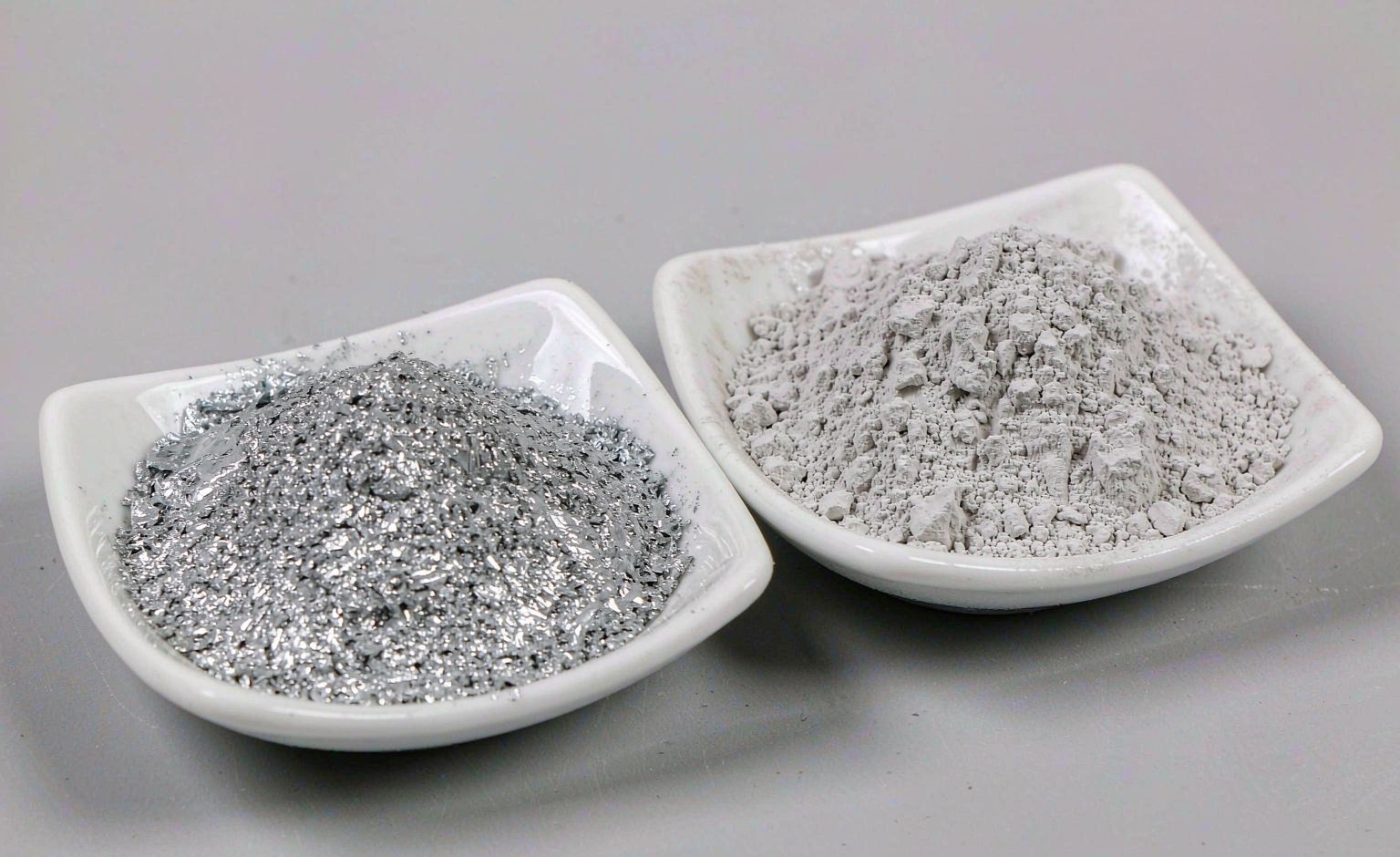
Aluminium powder is the workhorse of metallic silver effects. How it is made and, more importantly, how it orients in the film decides whether you get a mirror chrome look or a uniform satin metal.
Atomized powder is near-spherical and used where conductivity or filling matters; flake aluminium — produced by ball-milling foil with lubricant — is the form that gives metallic lustre because the flat flakes align parallel to the surface.
| Leafing | Non-leafing | |
|---|---|---|
| Orientation | Float to surface, overlap like fish scales | Disperse evenly through the film |
| Look | Mirror / chrome, maximum reflectivity | Uniform metallic, easy to overcoat |
| Use | Topcoats, reflective finishes | Industrial, tintable metallic bases |
Aluminium flake is a combustible dust. In powder or "wet" paste form it must be handled against dust-explosion risk — grounding, no ignition sources, and preferring pastes (already wetted) for many processes. We supply both dry and paste forms; pastes materially reduce handling risk.
Q: Why did my silver coating dull after a clear topcoat?A: You likely used a leafing grade under a solvent-strong topcoat that broke the surface leaf. For a stable metallic you can overcoat, choose non-leafing.
Q: Is aluminium powder dangerous to store?A: As a fine dust, yes — it is explosible. Stored as supplied (often wetted paste or sealed) and handled with basic dust-control, it is routine and safe.