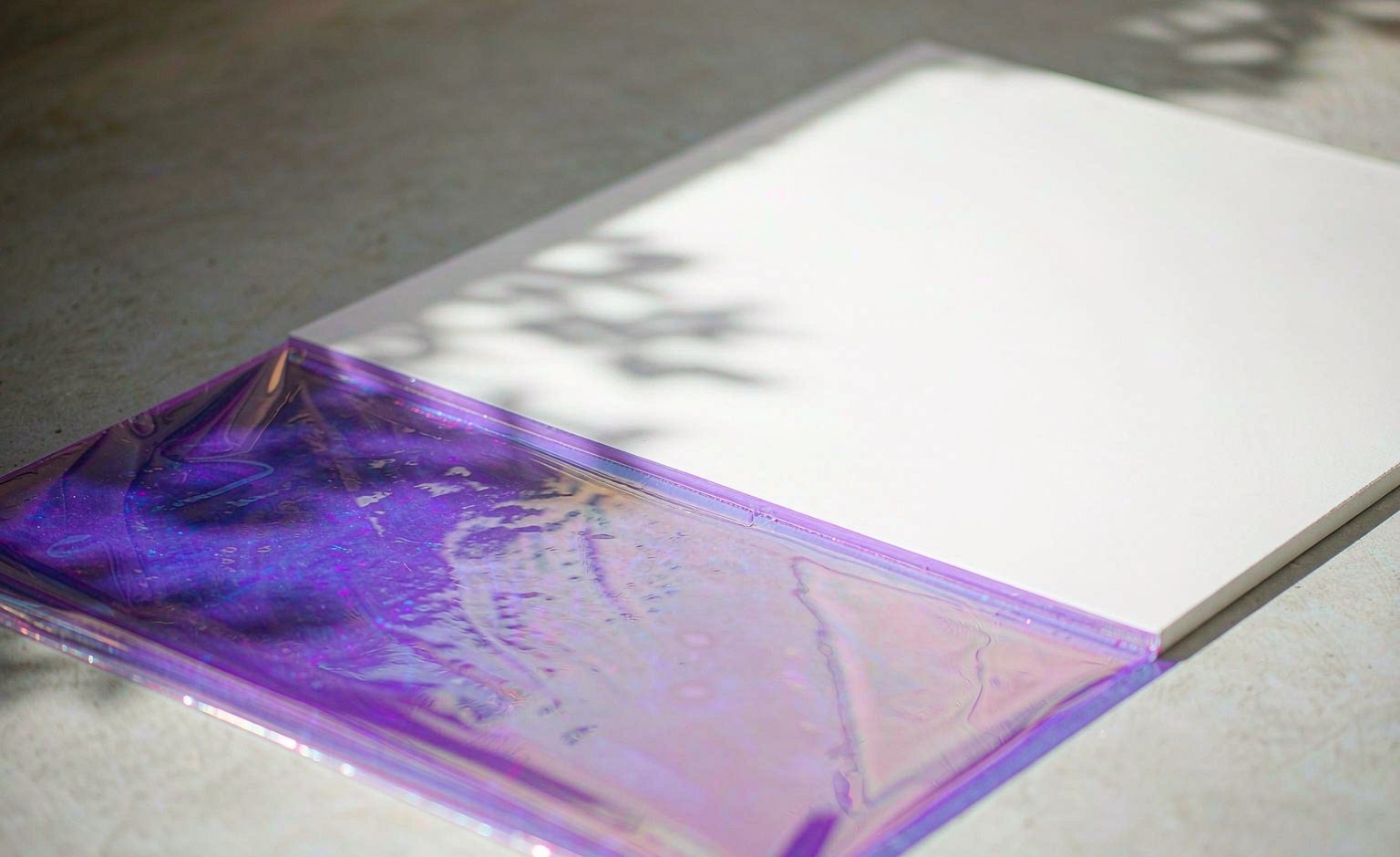
Photochromic pigments switch from colourless (or one colour) to coloured when exposed to ultraviolet light, then fade back when the UV source is removed. The effect is the same chemistry found in self-darkening eyewear, miniaturised into a pigment grade.
The active molecules — typically spirooxazine or spiropyran derivatives — exist in a closed, low-colour form in darkness. Absorbing UV photons opens the ring into a coloured, planar form. Remove the UV and the ring closes again. The visible colour is therefore a function of UV intensity, not of temperature.
| Parameter | Why it matters |
|---|---|
| Activation wavelength | Usually UVA (~365 nm); match to the light source you expect |
| Colour options | Common: blue, violet, grey, yellow, red — choose for contrast with base |
| Fatigue life | Number of UV on/off cycles before fading — the core durability limit |
| Particle size | Finer grades disperse better in clear systems |
Ideal for prints, toys, promotional items, nail art and packaging surprises where the "reveal under sunlight" moment is the point. Less suited to permanently outdoor-exposed surfaces where cumulative UV fatigue degrades the effect fastest.
Q: Will it change colour indoors under normal light?A: Standard indoor lighting has little UVA, so the change is weak; a window or sunlight, or a 365 nm lamp, triggers it clearly.
Q: Is photochromic the same as thermochromic?A: No. Photochromic is triggered by UV light; thermochromic is triggered by temperature (article 15). They can be combined in one product for layered effects.