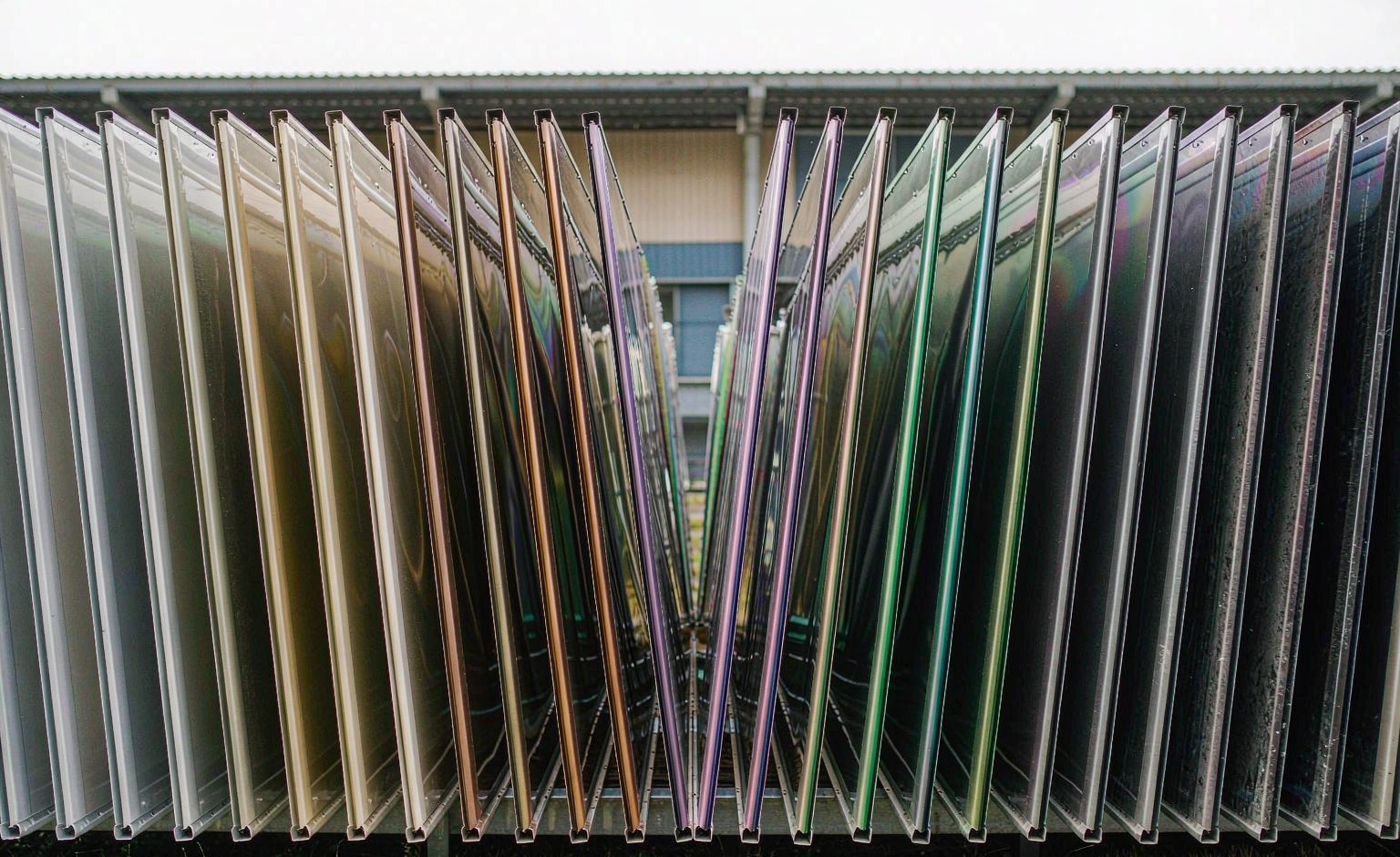
"Is your pearl pigment lightfast?" is a fair question with a misleading premise. Mica-based effect pigments are mineral and chemically stable; the failure you actually observe outdoors is almost always binder degradation revealing itself as chalking, gloss loss or colour drift. Specifying durability therefore means specifying the system, not the powder.
What actually degrades outdoors
- Binder resin: UV-induced chain scission causes chalking and gloss loss — the dominant failure mode.
- Topcoat clarity: a hazy or yellowing clear coat mutes the effect even if the pigment is untouched.
- Surface contamination: dirt and pollutant films reduce the specular reflection that makes a pearl effect work.
- Mechanical damage: abrasion and washing physically remove or disorient surface flakes.
The test methods buyers should recognise
| Method | What it does | Best for |
|---|
| ASTM G154 | Fluorescent UV / condensation cycling | Fast comparative screening of coating systems |
| ASTM G155 | Xenon-arc exposure, closer to full-spectrum sunlight | Correlation with real outdoor exposure |
| ISO 4892-3 | Plastics exposure to fluorescent UV | Moulded parts and masterbatched plastics |
| ISO 105-B02 | Colour fastness to artificial light, blue wool scale | Expressing a lightfastness rating |
How to write a durability specification that means something
- Specify the finished system. "Effect pigment with 1,000 h QUV, ΔE ≤ 2, gloss retention ≥ 80 %" is meaningful; "lightfast pigment" is not.
- State the exposure standard and cycle. ΔE figures without a stated method cannot be compared.
- Include gloss retention, not only colour. A pearl effect can hold its hue while the coating chalks flat.
- Test the real substrate. Performance on a metal panel is not transferable to a plastic moulding or a coated fabric.
- Retain a control. Keep an unexposed reference of the same batch; colour drift claims are only defensible against a control.
Specification note: Figures such as particle-size brackets, heavy-metal limits and MOQ are shown as typical industry ranges; confirm final values against the COA/TDS for your batch.
Q: Do interference pigments fade differently from absorbing pigments?
A: Their colour comes from structure rather than from a dye molecule, so they do not "bleach" the way organic colourants do. What changes outdoors is how much light reaches the structure — hence the dependence on the binder and topcoat.
Q: Can I use an interior grade outdoors?
A: The pigment may well survive; the coating carrying it probably will not. Choose the binder system for the exposure first, then the pigment grade for the look.
Sources: ASTM G154 ASTM G155 ISO 4892-3 ISO 105-B02 ISO 787 .
SC
Technical Director, EFFECT-PIGMENT — writes on pigment specification, compliance and application engineering.
← Back to Info Center