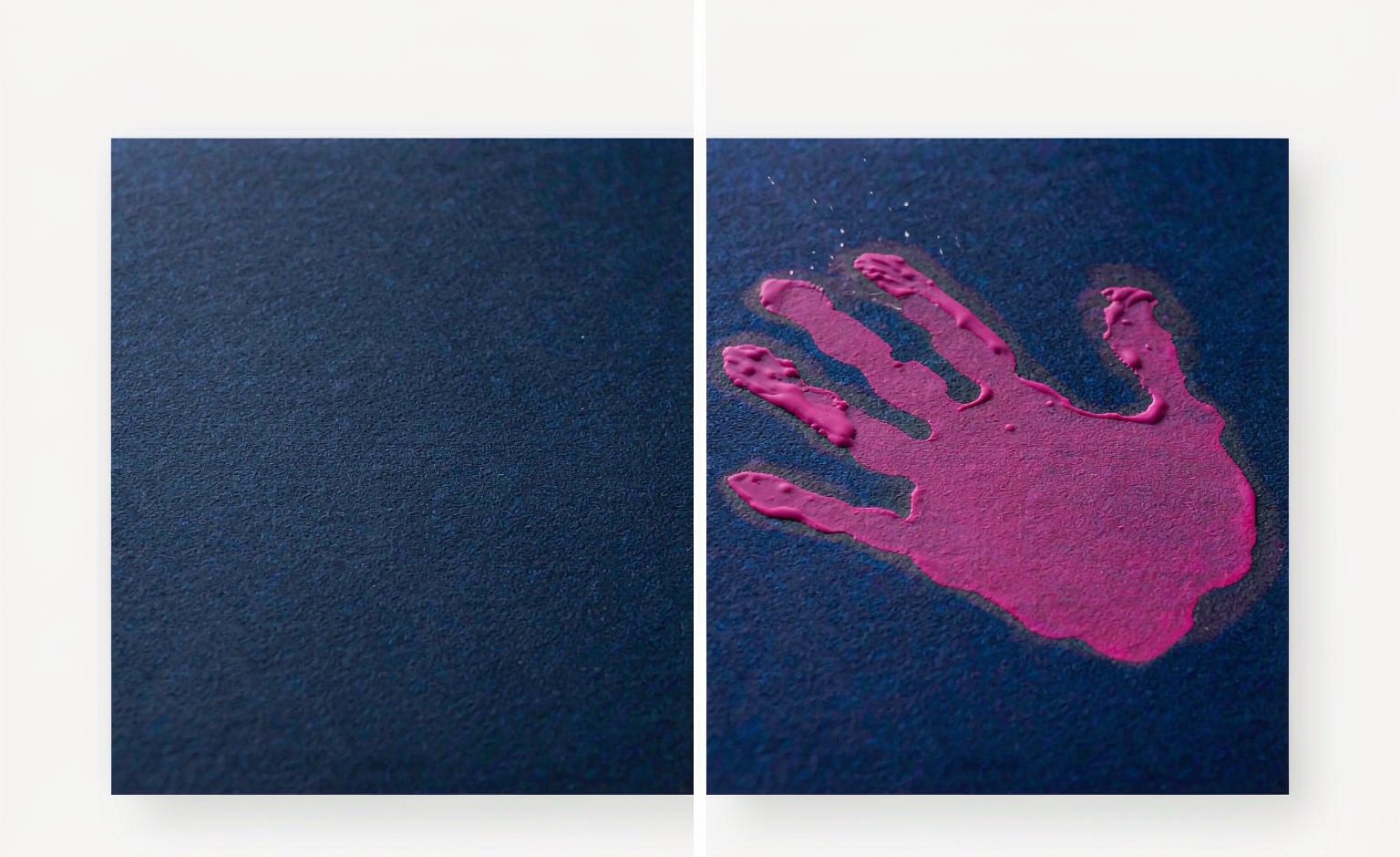
A thermochromic pigment is a leuco dye, a colour developer and a solvent sealed inside a polymer capsule a few micrometres across. The capsule wall — its material, its thickness and its integrity — decides how much heat, solvent and shear the product survives. Specification starts with the capsule, not with the colour.
Buyers compare thermochromic pigments by shade and activation temperature. Both are consequences of the capsule rather than separate properties, which is why two powders that look identical in a jar can behave completely differently in the same coating.
Three components are sealed together: a leuco dye that carries the colour, a developer that holds the dye in its coloured form, and a low-melting solvent that sets the switching point. Below the activation temperature the solvent is solid, dye and developer stay paired and the colour shows. Above it the solvent melts, the pairing breaks, the dye turns colourless, or shifts to a second colour in a two-dye system, and the colour returns once the melt solidifies.
A wall around 0.2 to 0.5 µm thick is all that stands between that chemistry and your binder. The wall material sets solvent resistance: one that survives a mild solvent-borne coating may swell in an aggressive ester or ketone. Wall thickness sets mechanical survival: bead milling, high-shear dispersion, fine filtration and sharp fillers can rupture it. Heat is a separate limit — a process run near the melting point of the internal solvent will shift or destroy the effect even when the capsule itself survives.
Three mechanisms account for most complaints. Rupture, from shear or grinding, releases the chemistry into the binder and the colour disappears locally or across the batch. Leakage without rupture lets the solvent migrate slowly, so the pigment works at first and fades over weeks. Dye migration into a plasticiser or a solvent-rich topcoat pulls colour out of the capsule over time, which is why wall compatibility matters in flexible PVC and in some ink systems.
Treat these as limits to design within, then confirm against the batch TDS: normal processing at 160–180 °C with 220 °C as the ceiling, and a brief 230 °C peak of about ten minutes at most; add the pigment late at low to moderate shear and avoid bead milling and fine filtration afterwards; keep the system away from strong alkali, which attacks the wall; and store the powder sealed and dry, out of direct sun, with shelf life counted from the production date on the label rather than from the day you open it.
Q: Why did my pigment stop working after processing?A: Almost always the wall. Shear from milling or filtration, a solvent the wall cannot take, or a temperature spike above the internal melting point. Run the same grade with no processing in the same base to isolate which of the three it was.
Q: Can it be used in water-based systems?A: Only with care. Many walls are sensitive to prolonged water contact and to high pH. If your system is aqueous, say so at the quotation stage and ask for the water-borne recommendation instead of assuming the solvent grade will do.
Q: Does a clear topcoat change the activation point?A: It can shift it slightly by insulating the capsule, and a solvent-rich topcoat can attack the wall before it dries. Choose a topcoat compatible with the wall material and test the finished article, not just the film.
Q: How should the pigment be stored and handled?A: Sealed, dry and out of direct sun. Weigh out what you need, reseal the rest, and do not leave pigment sitting in an open container in a humid room; caked powder means moisture, and moisture is what the wall tolerates least.