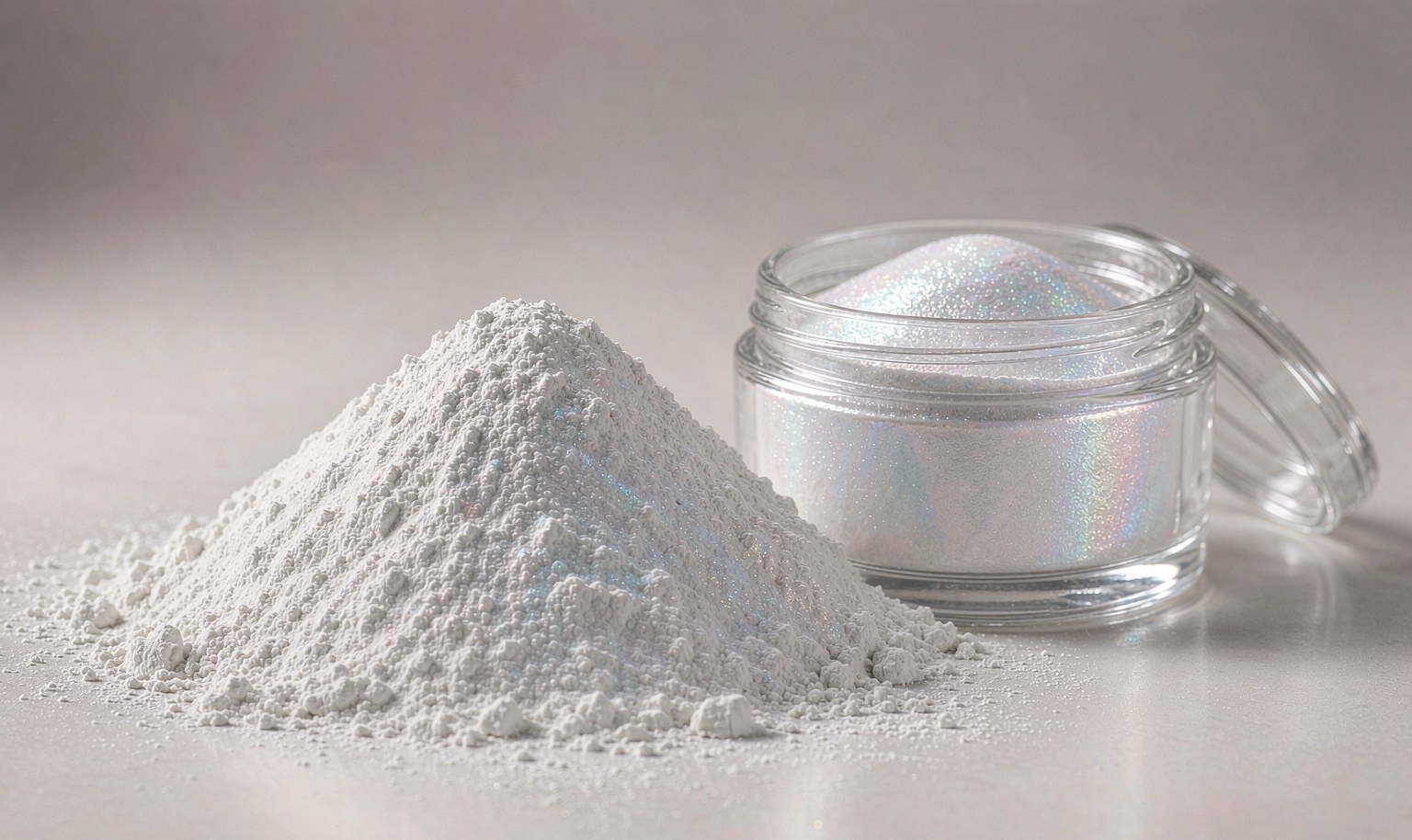
If you formulate cosmetics, personal care or decorative products for the European market, you have almost certainly seen the phrase "microplastic ban" appear in compliance briefings. It is real, it is phased, and — importantly for pigment buyers — it draws a clear line between synthetic polymer particles and the mineral-based effect pigments most formulators actually use.
This article explains what the EU microplastic restriction actually covers, the deadline timeline that matters for cosmetics, and why mica-based pearl pigments sit comfortably outside the restriction while conventional PET glitter does not.
The restriction comes from Commission Regulation (EU) 2023/2055, adopted on 25 September 2023 and in force since 17 October 2023. It amends Entry 78 of Annex XVII to REACH (Regulation (EC) No 1907/2006), restricting the placing on the EU market of synthetic polymer microparticles — either on their own or intentionally added to mixtures — at a concentration of 0.01 % by weight or more.
The definition targets solid synthetic polymer particles smaller than 5 mm (or fibres no longer than 15 mm with a length-to-diameter ratio above 3) that are insoluble and not readily biodegradable. The goal is to cut the release of persistent microplastics from everyday products into the environment.
The restriction is not a single deadline. For cosmetics it is staggered by product type, giving industry time to reformulate:
| Product category | Ban applies from |
|---|---|
| Rinse-off products containing exfoliating/cleansing microbeads | 17 October 2023 (already in force) |
| Rinse-off cosmetic products (general) | 17 October 2027 |
| Leave-on cosmetic products | 17 October 2029 |
| Lip, nail and make-up products | 17 October 2035 |
From 17 October 2031, make-up, lip and nail products that still contain microplastics must carry an on-pack statement identifying the microplastics present.
Other relevant categories: detergents, waxes, polishes and air-care products (17 October 2028); fragrance encapsulation (17 October 2029); plant-protection and biocidal products (17 October 2031); granular sports-surface infill (17 October 2031).
The restriction captures intentionally added synthetic polymer microparticles. The most visible cosmetic examples are exfoliating microbeads and conventional plastic glitter made from PET or other synthetic polymers.
Crucially, the restriction explicitly excludes materials that are not synthetic polymer microparticles:
In plain terms: a shimmer effect created with mica-based pearlescent pigment is an inorganic mineral effect, not a synthetic polymer microparticle, and therefore falls outside the scope of the microplastic restriction. Conventional PET or OPP glitter, by contrast, is a synthetic polymer and is within scope for the phased cosmetics deadlines above.
For pearl-pigment users: if your shimmer comes from mica and TiO₂-coated pearlescent pigments, you are working with inorganic mineral particles. They are not captured by Regulation (EU) 2023/2055, so the microplastic restriction is not a barrier to using them in EU cosmetics — provided the rest of your formulation complies. This makes mica pearlescent pigments a straightforward, naturally compliant route to shine.
For glitter users: conventional plastic glitter is in scope. If you use PET or other synthetic-polymer glitter in leave-on or decorative cosmetics, plan your reformulation timeline against the 2029 and 2035 deadlines (and the 2031 labelling requirement for long-deadline categories). Many brands are moving ahead of the deadlines to avoid a "contains microplastics" label that eco-conscious shoppers react negatively to.
A note on edible-effect pigments: the microplastic restriction governs products placed on the EU market generally, including food-contact and cosmetic applications. For food-grade shimmer, a separate and often-cited topic is the E171 (titanium dioxide) food-additive restriction (EU Regulation 2022/63) — a different legal measure from the microplastic ban. The two should not be conflated.
At EFFECT-PIGMENT we manufacture mica-based pearlescent pigments, glitters and edible-effect pigments under a certified quality system (FDA, Kosher, ISO 9001, GMP). Because our core pearl pigments are inorganic mineral effects, they sit outside the EU microplastic restriction by their nature.
We can support your compliance work with:
If you are reformulating ahead of the 2027–2035 deadlines and need a mineral-based shimmer alternative to plastic glitter, our team can map a pearl-pigment option to your application.
Q1: Does the EU microplastic ban prohibit mica pearl pigment?
No. The restriction targets synthetic polymer microparticles. Mica-based pearlescent pigments are inorganic mineral particles and are outside the scope of Regulation (EU) 2023/2055.
Q2: Is conventional PET glitter banned in the EU?
It is restricted on a phased timeline. Microbeads in rinse-off products were banned from October 2023; rinse-off cosmetics generally from 2027; leave-on from 2029; and lip, nail and make-up products from 2035 (with a labelling requirement from 2031).
Q3: What exactly is a microplastic under this regulation?
A solid synthetic polymer particle smaller than 5 mm (or fibre of 15 mm or less with a length-to-diameter ratio above 3) that is insoluble and not readily biodegradable, when intentionally added at 0.01 % by weight or more.
Q4: Is this the same as the E171 / titanium-dioxide ban?
No. The microplastic restriction is Regulation (EU) 2023/2055 under REACH. The E171 restriction (EU Regulation 2022/63) is a separate food-additive measure. They address different substances and should not be confused.
Q5: Can EFFECT-PIGMENT provide compliance documentation?
Yes. We supply COA, TDS and SDS per order, and can confirm the material base (mica vs. synthetic polymer) for each product to support your regulatory file.
Planning a reformulation ahead of the EU microplastic deadlines? Talk to our team about mineral-based pearl-pigment alternatives to plastic glitter, or request a free sample to verify the effect yourself.