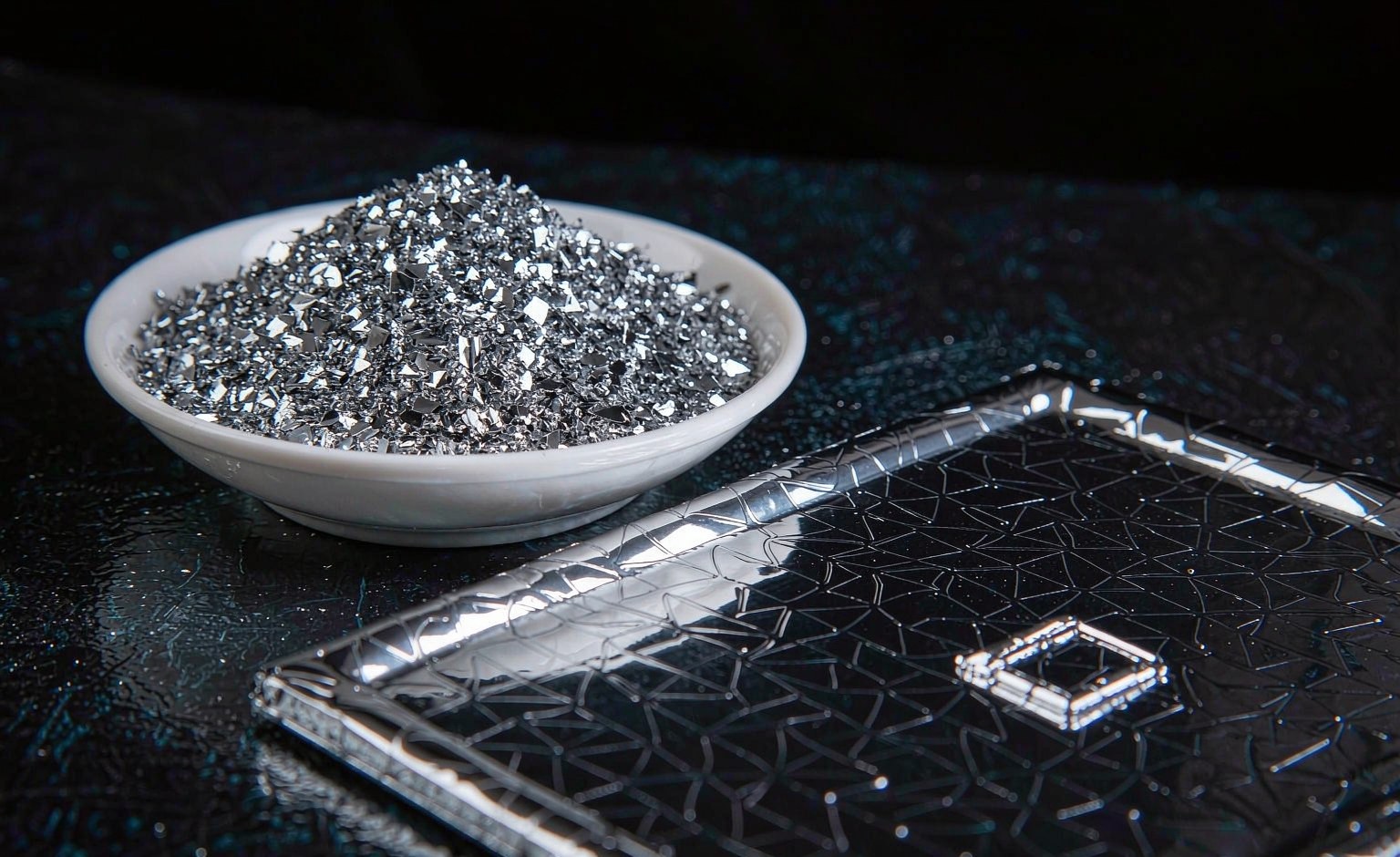
If you want the brightest possible silver-white with the sharpest highlight, the substrate matters more than the coating thickness. This is why silver-coated glass flake pigments have largely displaced mica in demanding applications — and why "silver pearl" is not one product but a family with very different performance.
| Substrate | Surface quality | Luster character | Typical use |
|---|---|---|---|
| Natural mica | Irregular, some iron tint | Warm, soft satin | General decorative, cost-sensitive |
| Synthetic mica | Regular, low tint | Cleaner whiteness, better sparkle | Cosmetics, premium decorative |
| Glass flake | Very smooth, uniform thickness | Sharpest highlight, highest chroma | Mirror chrome, automotive, premium nail |
| Alumina flake | Smooth, plate-like | Very bright, strong sparkle | Specialty high-sparkle effects |
The mechanism is straightforward: a pearl effect comes from specular reflection off many aligned plates. The smoother and more uniform those plates, the more the reflected light recombines into a single bright highlight instead of scattering. Glass flake wins because its surface and thickness are controlled by the manufacturing process rather than by geology.
Coating the flake with a reflective metal layer raises reflectance well above what a metal-oxide interference stack can achieve alone, producing a near-chrome appearance. In cosmetic and decorative contexts the metal used is typically silver, referenced under its colourant index entry. Two consequences matter commercially:
Q: Why does my silver look grey in the finished film?A: Two usual causes — the pigment is not oriented parallel to the surface (poor flow or wrong solvent balance), or the base coat is light and scattering. Darken the base coat and improve leveling.
Q: Is silver-coated pigment suitable for food decoration?A: Do not assume so. Body-contact and food-contact status depends on the specific metal and its regulatory listing in your market. Ask for the declaration for the exact grade.