
Pearl pigment particle size decides how a cosmetic product looks and feels before colour even enters the conversation. Fine pearlescent grades in the roughly 5–20 µm band give satin sheen, better coverage and a smoother skin feel; coarse grades from about 40 µm upward give strong sparkle and transparency at the cost of texture. This guide explains the trade-offs across the 5–100 µm range, shows how to choose by application, and covers the pressing, dispersion and documentation issues that decide whether a shade actually ships. Browse our full pearlescent pigment catalogue for the grades referenced below.
As Technical Director at EFFECT-PIGMENT (Hangzhou) Co., Ltd., I work with pearl pigment buyers across Europe, the Americas, the Middle East and Southeast Asia — from nail-care brands to colour cosmetics OEMs. The question they ask most often is not about colour. It is particle size: the same pigment at 5 µm and at 60 µm feels like two different products on skin. This guide lays out the particle-size trade-offs formulators run into most often.
— Steve Chan, Technical Director, EFFECT-PIGMENT (Hangzhou) Co., Ltd.
Every pearlescent pigment is a mica platelet coated with metal oxide — usually TiO₂ or iron oxide. The platelet's diameter relative to its thickness controls how light reflects off the surface. Small platelets lie close together in the film, reflect light in a tight, even pattern and read as satin or silk. Large platelets sit further apart, act like tiny mirrors and read as glitter or sparkle.
That optical behaviour is why "which particle size should I use?" is an effects-versus-feel question, not a quality question. A 5 µm silver white and a 60 µm silver white can come from the same production line and share the same colour index; they simply occupy different points on the sparkle–smoothness spectrum. Neither is better. Formulators who fix the particle size decision first — before colour matching — avoid the most expensive rework loop in cosmetics development: reformulating a pressed powder or a nail lacquer because the pearl reads wrong on skin.
Diameter, however, is only half of the optical story. What is coated onto the mica matters just as much. A single TiO₂ layer produces classic silver-white pearl; repeated or combined oxide layers build pearl intensity step by step; alternating transparent layers of different refractive index produce interference colours that shift with the viewing angle — colour travel. This is why two pigments with an identical particle size can sit at completely different points on the "subtle to dramatic" scale: the size sets the texture, the coating sets the drama. When a formulator briefs a supplier, both numbers belong in the conversation — size band and coating system — because the interplay between them, not either one alone, defines the final effect on skin.
Three practical consequences follow from this:
Cosmetic-grade pearlescent pigments typically span a continuous gradient of roughly 5–100 µm. The bands below describe industry-typical behaviour; our own grade families are 5–25 µm (cosmetic base pearl), 10–40 µm, 10–60 µm, 20–100 µm and 40–200 µm (art range), with D50 confirmed per grade on the TDS.
| Band | Optical effect | Skin feel | Typical use |
|---|---|---|---|
| ≈5–20 µm | Satin sheen, soft focus, high coverage | Smooth, creamy | Foundations, lipsticks, pressed powders (base pearl) |
| ≈20–40 µm | Balanced pearl with visible lustre | Silky with slight glow | BB/foundation glow, blush, eyeshadow |
| ≈40–60 µm | Clear sparkle begins, good transparency | Noticeably textured | Highlighters, nail lacquer, body shimmer |
| ≈60–100 µm and above | Strong glitter sparkle, maximum transparency | Coarse; perceptible flakes | Nail polish/gel, festival/body glitter, hair shimmer |
Two notes on the table. First, colour strength and transparency move in opposite directions: as particles get coarser, coverage drops but each flake becomes more brilliant, which is why coarse grades are often used over a base rather than as the base. Second, these are directional industry ranges. Actual behaviour depends on the coating system (TiO₂, interference, iron oxide), the platelet thickness and the carrier film — always confirm against the TDS of the specific grade.
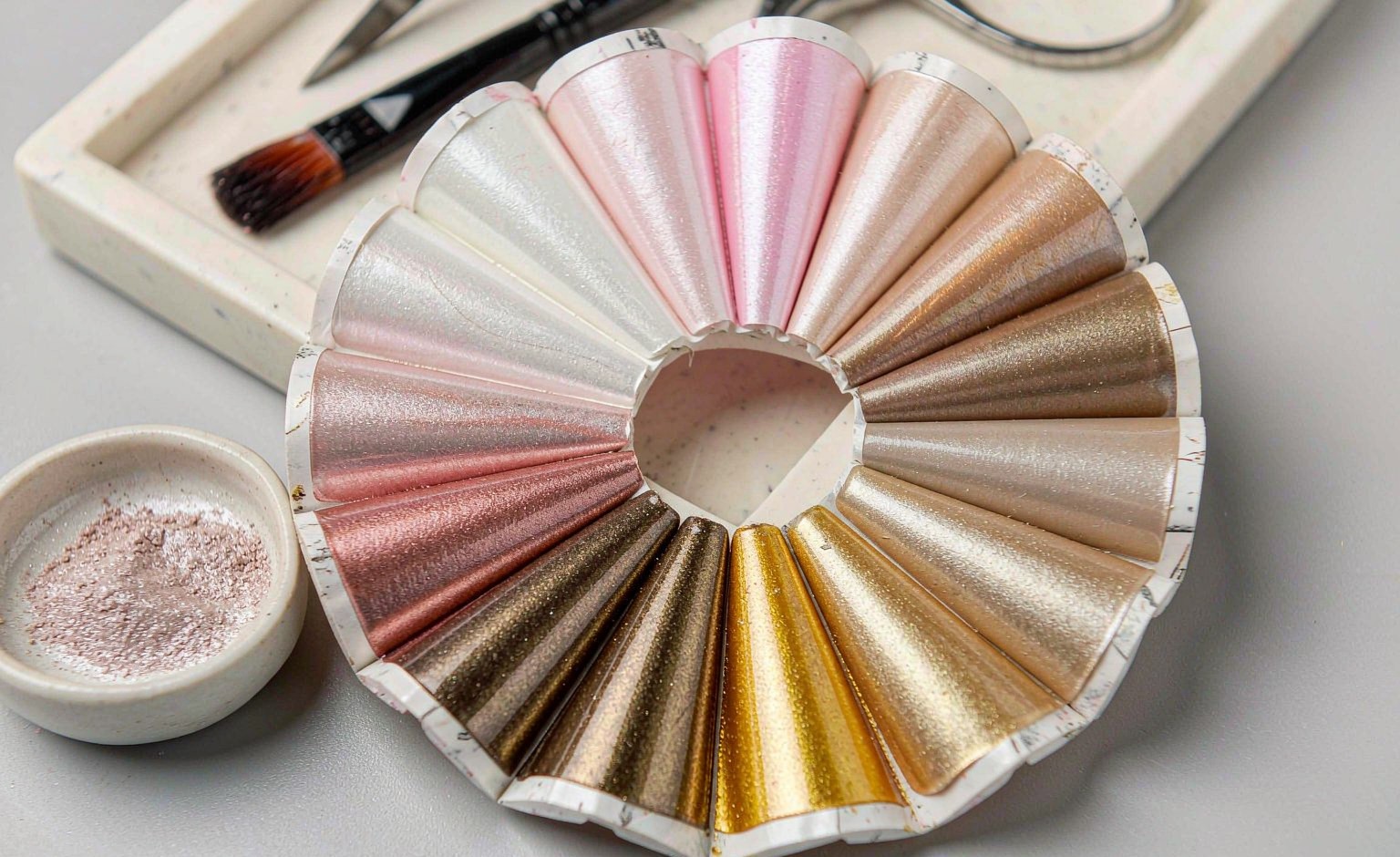
Lips (lipstick, lip gloss). Lip skin is thin, and the product has an incidental-ingestion exposure scenario, so texture and grade selection both tighten. Most lip formulations sit in the small-to-mid satin bands, where pearl reads as shine rather than glitter. Coarse flake in a lip product brings both a rough feel and swallowing considerations, so any coarser grade must be evaluated per grade against its TDS. Compliance paperwork for lip products is the full cosmetic package: COA, heavy-metal report, TDS and SDS. See our cosmetic-grade pigment application guide for shade-by-shade notes.
Face (foundation, pressed powder, blush, highlighter). Face formulas usually combine two pearl sizes: a fine grade as the structural base pearl and a mid/coarse grade as a visible top-note sparkle. This is the essence of particle-size distribution thinking — the blend, not the single grade, creates the effect. In pressed powders the fine fraction also acts as part of the pressing skeleton, which matters for the next section.
Nails (nail lacquer, gel polish). Nail systems are the natural home of large flakes. The technical questions shift from skin feel to suspension stability and brush-out uniformity: large platelets settle, so rheology and anti-settling additives decide whether the flakes stay dispersed — our technical team recommends grade-specific anti-settling systems on request, confirmed against the TDS.
Hair and body shimmer. Here coarse grades are the point, not a compromise. The constraints are regulatory (decorative-use categories) and mechanical (flake adhesion to the carrier — stick, spray or gel).
A quick word on a distinction that surfaces in almost every cosmetics pearl consultation. Regular pearl pigment carries a coating that produces a fixed hue: a ruby pearl reads ruby from every angle. An interference pigment carries transparent, precisely stacked layers that produce no colour of their own — instead, the colour appears through light interference and travels with the viewing angle. On a white base an interference pigment reads as a delicate, angular shift of hue; over a coloured base it overlays a second, moving dimension of colour.
The practical consequence for product design: interference grades are the natural choice when the brief calls for understated, "quiet luxury" colour movement — a mascara base with a subtle teal flash, a pressed powder with a soft pink-to-champagne travel — while regular pearl delivers reliable, fixed colour payoff. The two families are often used together: regular pearl for body colour, interference for the moving highlight on top. Both follow the same particle-size logic described above; interference simply adds angle-dependent colour on top of the texture decision.
The second recurring question is the substrate itself. Natural mica is mined, well established across decades of cosmetic use, and cost-efficient — the workhorse of the industry. Synthetic mica (synthetic fluorphlogopite) is grown rather than mined: its platelets are purer and more uniform, colours read cleaner and more transparent over it, and its heavy-metal background is inherently lower — which is why it appears so often in premium and eye-area products. The trade-off is cost.
The honest selection guidance is positioning-driven, not technical superiority: high-transparency shades, tight heavy-metal budgets and premium positioning favour synthetic mica; proven performance at scale and cost structure favour natural mica. Both substrates follow the same particle-size and pressing logic in this guide. Confirm the substrate (natural or synthetic mica) of the specific grade against its TDS.
Pressed powder cracking or pan drop is not only a particle-size problem. Pressability depends on three things together: the particle-size distribution (fine grades build the skeleton, sparkle grades sit as decoration), the pressing pressure, and the binder system. Too high a proportion of large flakes weakens the pressing skeleton and the cake cracks or dusts. The useful answer for a formulator is a blend recommendation — a ratio of fine structural pearl to coarse decorative pearl — rather than a single grade — our technical team can propose a starting blend ratio for your pressing system on request.
Dispersion is where coarse grades die. Large platelets are mechanically fragile. High-shear, long-duration milling breaks them into smaller, duller fragments — the sparkle is physically destroyed and cannot be recovered. Standard practice for coarse pearl and glitter grades is post-adding: disperse the base first, then fold the pearl in with low-shear mixing at the final stage. For fine grades this matters less, but the low-shear principle still protects interference and thinner coatings.
The difference between cosmetic grade and industrial grade is not the chemistry of the platelet — it is the control envelope around it:
One boundary worth restating for buyers: cosmetic grade is not edible grade. A cosmetic-grade pearl pigment is documented for cosmetic use, not for ingestion. For food-decoration use cases, the edible glitter line with its own food-contact documentation is the correct entry point — the two must not be mixed up in a formulation brief.
We document our quality and certification system and our certificates in full. On TiO₂: regulatory tightening of E171 has focused on food applications (the EU has discontinued E171 as a food additive). In cosmetics, TiO₂ (CI 77891) remains a permitted colorant, with attention continuing around powder-inhalation exposure scenarios. We state the regulatory distinction only — no legal conclusions — and recommend buyers track their target market's updates or consult a regulatory specialist. (See our blog on the EU microplastics regulation for adjacent packaging-era compliance reading.)
| Term | Meaning |
|---|---|
| mica | The mineral substrate of pearlescent pigment: a platelet of muscovite-type mica. |
| TiO₂ | Titanium dioxide, the coating layer on mica; under food rules it is E171, under cosmetic rules it is CI 77891. |
| pearlescent pigment | A pigment made of mica platelets coated with metal oxide, giving a pearl / satin / sparkle effect. |
| interference pigment | A transparent, precisely stacked coating that produces angle-dependent colour (colour travel) with no fixed hue of its own. |
| D50 | Median particle size: 50% of particles by volume are smaller than this value. |
| particle size distribution | The blend of fine and coarse fractions (grading) that together create the effect. |
| color travel | The shift of apparent colour with the viewing angle, produced by interference coatings. |
| skin feel | The tactile sensation of the pigment on skin; coarser grades read as textured or gritty. |
| pressed powder / pressability | Compact powder; pressability is how well the cake holds together under pressing pressure. |
| synthetic mica | Lab-grown fluorophlogopite; purer, more uniform platelets with a lower heavy-metal background than mined mica. |
| heavy metal limits | Cosmetic-grade limits on heavy metals, tested and reported per lot. |
| cosmetic grade | Documented for cosmetic use (heavy-metal limits, GMP workshop, per-lot COA/TDS/SDS) — not for ingestion. |
Q1: Why do the same pearlescent powders look completely different on skin at 5 µm vs 60 µm?
Particle size decides the optical form. Fine grades around 5–20 µm reflect light in an even pattern and read as satin with better coverage and skin feel; coarse grades around 40–100 µm and above act like tiny mirrors, giving sparkle and transparency but a coarser feel. Neither is better — it is an effect-versus-feel trade-off. Confirm the exact grade behaviour against its TDS.
Q2: Which particle size should I use for lipstick or lip gloss?
Lips are texture-sensitive and the product has an incidental-ingestion exposure scenario, so most lip formulas use small-to-mid satin bands where pearl reads as shine. Coarse flakes bring roughness and swallowing considerations and must be evaluated per grade. We confirm suitability per grade and provide the cosmetic-grade document pack: COA, heavy-metal report, TDS and SDS.
Q3: My pressed powder cracks or drops powder — is that a particle size problem?
Not only. Pressability depends on the particle-size blend (fine grades build the skeleton, coarse grades decorate), the pressing pressure and the binder system. Too many large flakes weaken the cake. The practical fix is usually a blend-ratio recommendation rather than switching a single grade — our technical team can propose a starting ratio for your system.
Q4: What is the difference between cosmetic grade and industrial grade pearl pigment?
The control envelope, not the chemistry: cosmetic grades carry tighter heavy-metal limits, are produced under GMP-managed workshops, and ship with complete documents (COA, heavy-metal report, TDS, SDS) per lot. Note that cosmetic grade is not edible grade — cosmetic-grade pigment is documented for cosmetic use, not for ingestion.
Q5: Is TiO₂ (E171) going to be banned? Should I switch?
Regulatory tightening has focused on food: the EU has discontinued E171 as a food additive. In cosmetics, TiO₂ (CI 77891) remains a permitted colorant, with attention on powder-inhalation scenarios. We state the distinction without legal conclusions — track your target market's rules or consult a regulatory specialist before reformulating.
Request cosmetic-grade TDS / SDS / COA and a particle-size selection shortlist for your application.