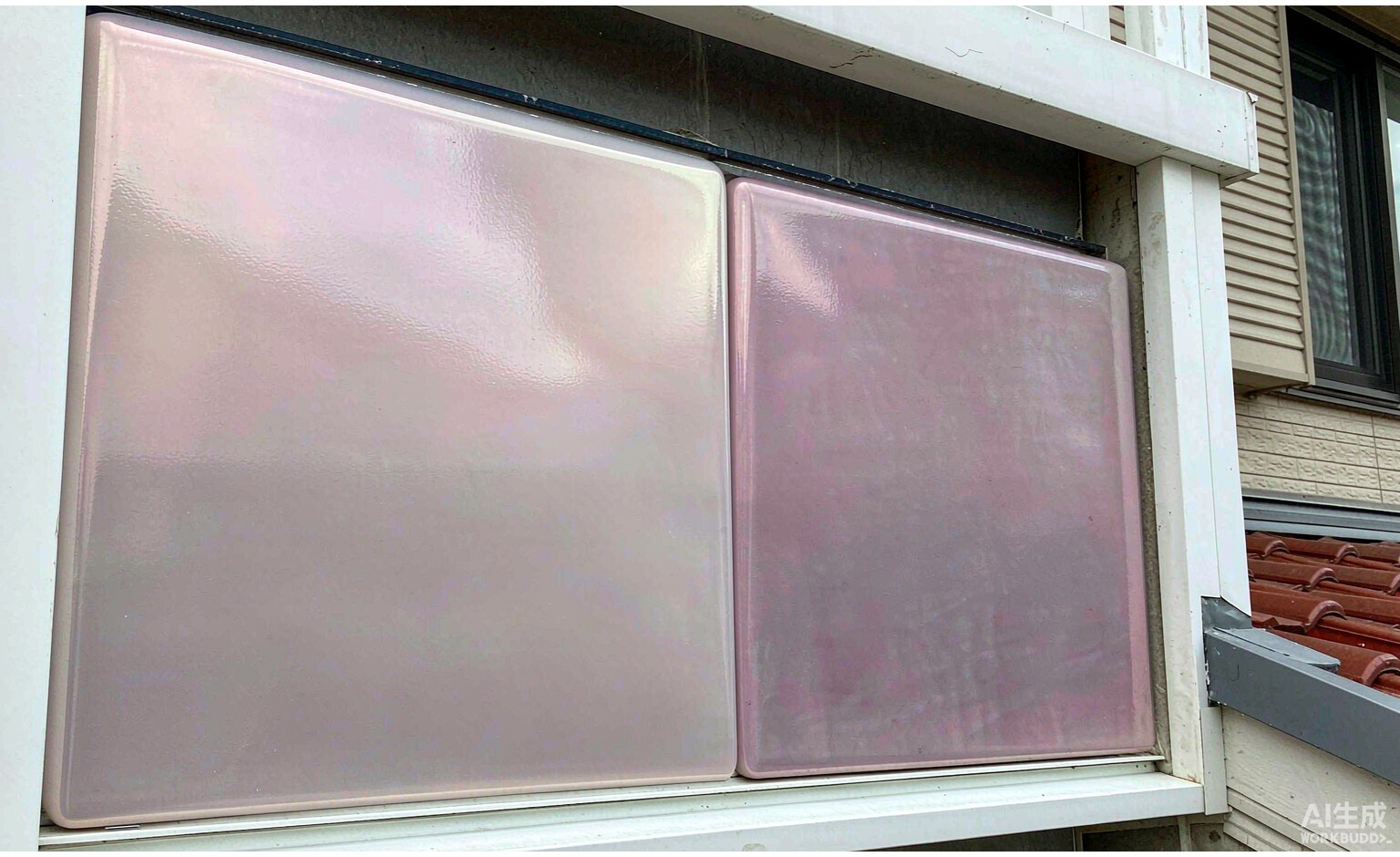
BLUF — A pigment that looks perfect in the lab can shift, haze or dull within a season outdoors. Outdoor durability is a separate specification from shade or shimmer. If your product lives outside — building façades, plastic panels, automotive trim — you need to spec for weathering, not just appearance.
Indoor decorative effects are judged by colour and sparkle. Outdoor parts are judged by what survives: UV radiation, temperature swings, humidity and surface abrasion. A pearlescent pigment that is stable on a display shelf may still lose interference colour or develop grey haze when the coating ages under sun and rain. Durability, not beauty, becomes the buying criterion.
Most pearlescent pigments are built on a mica platelet with a TiO₂ (or alternative) coating. Two mechanisms matter outdoors:
The substrate (mica) itself is chemically stable; the vulnerability is at the coated interface and in how the pigment is protected by the binder system.
You cannot "make mica UV-proof" by wishful thinking, but you can spec around the weakness:
Never scale on a shade match alone. Request samples and run a real weathering check: place coated panels under accelerated UV or, better, a monitored outdoor exposure, then compare interference colour and haze against a control. A short validation cycle up front prevents a recall-grade failure later.
Q1: Do pearlescent pigments fade in sunlight?
They can lose interference colour or develop haze outdoors if the coated interface is unprotected, because TiO₂ is photoactive under UV. Using a weather-resistant treated grade and a UV-stable binder/topcoat greatly reduces the risk. Always validate with a weathering test before scaling.
Q2: What is a weather-resistant coating on mica pigment?
It is an added surface treatment (commonly SiO₂ or SnO₂ over-coat) layered on the pearlescent platelet to buffer the TiO₂ interface and improve stability under UV and moisture. It is a grade option, not a default — confirm availability for your specific colour with the supplier.
Q3: Can I use standard pearl pigment in exterior paint?
Only if the grade is documented for exterior use. Standard decorative pearl may haze or drift outdoors. For façades and panels, choose a weather-resistant or exterior-grade pigment and pair it with a UV-stable resin and clear topcoat, then verify by test.
Q4: How do I test colour fastness before mass production?
Request samples and coat test panels, then expose them to accelerated UV or monitored outdoor conditions and compare interference colour and haze against a control panel. A short validation cycle catches durability problems before they reach the field.
Q5: Does particle size affect outdoor durability?
Particle size influences dispersion and edge area, which can affect how the coated interface ages, but the effect is system-dependent. Finer platelets are not automatically "more durable" — the binder, topcoat and grade choice matter more. Validate in your actual formulation.
Request weather-resistant pearlescent samples and matching weathering data for your exterior application.