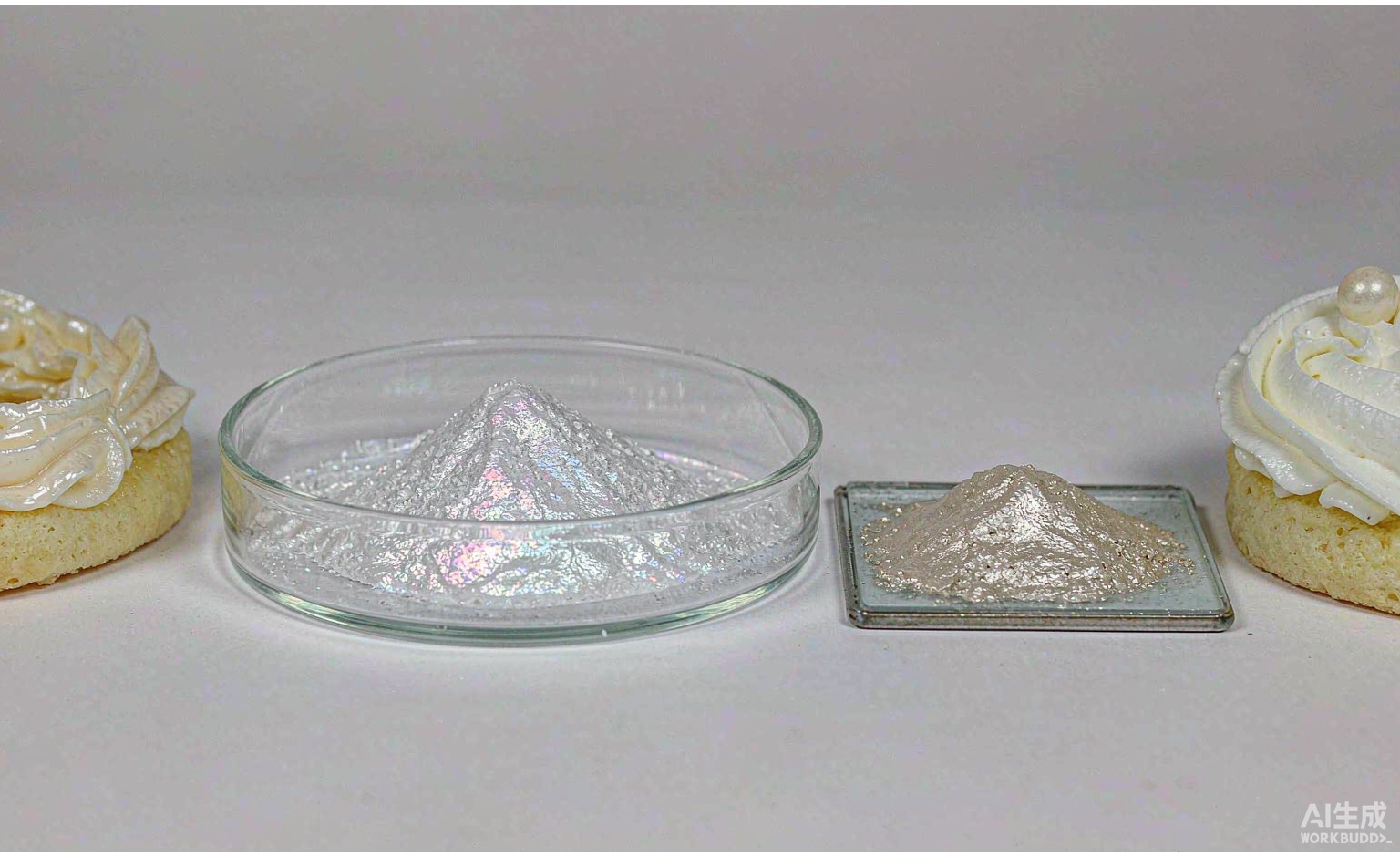
BLUF — For pigment and glitter buyers, "E171-FREE" and "TiO₂-Free" are not marketing fluff; they are compliance checkpoints. If your product touches food or sits on skin, the presence of titanium dioxide as a colourant changes what you can legally and safely formulate. This guide explains the terms in plain language and gives you a checklist to use with any supplier.
Titanium dioxide (TiO₂) is a white, high-refractive-index mineral used across coatings, plastics and pigments. In the food world it is known as E171 when used as an additive. Regulators have restricted E171 in food applications on safety-review grounds, which means finished food products can no longer rely on TiO₂ as a whitening or brightening additive.
"TiO₂-Free" as a pigment claim simply means the product does not use titanium dioxide as a coating or colourant layer. It is a factual composition statement — not a quality grade.
Classic pearlescent (luster) effects come from a thin, high-refractive layer deposited on a platelet substrate — most commonly mica. The traditional coating is TiO₂, whose refractive index creates the signature pearl shine.
That creates two families buyers should understand:
The key takeaway: "pearlescent" does not automatically mean "contains TiO₂," but the most common commercial route does use it. Ask the question explicitly.
Product availability (confirmed): Our food-grade pearlescent line is offered in both routes — standard TiO₂-coated mica grades and TiO₂-Free (no-titanium) grades — differentiated by product model / item code. For food-contact decorative use, specify the TiO₂-Free grade and request its FDA / Kosher documentation and TDS/SDS/COA on file.
Treat "TiO₂-Free" as a spec line, not a slogan. The fastest path is to shortlist suppliers who can hand you a composition statement, the right food/cosmetic certifications, and sample batches you can test. Pair that with the outdoor-durability and glitter-sizing guides linked below to complete your effect-pigment spec sheet.
Q1: Is titanium dioxide (E171) banned in the EU?
Regulators have restricted E171 — titanium dioxide used as a food additive — on safety-review grounds, so finished foods can no longer use it as a whitening agent. The restriction targets food additives specifically; industrial and many cosmetic uses follow different rules. Always check the latest applicable regulation for your market.
Q2: Are all pearlescent pigments made with TiO₂?
No. The most common commercial route deposits a TiO₂ coating on mica to create pearl shine, but alternative metal-oxide coatings exist that avoid TiO₂ entirely. A "TiO₂-Free" pigment is a factual composition claim — ask the supplier for the written statement rather than assuming.
Q3: Can I use mica-based pearlescent pigment in food?
Only if the specific grade is documented for food-contact decorative use and carries the right certifications (such as FDA and Kosher where applicable) with TDS/SDS/COA on file. Mica itself is a mineral substrate; the coating layer is what determines food compliance, so verify the whole composition.
Q4: What does "TiO₂-Free" mean for cosmetic safety?
It means the pigment does not use titanium dioxide as a coating or colourant, helping formulators keep TiO₂ out of a formula where they prefer an alternative. It is a composition fact, not a safety certification by itself — pair it with the supplier's full documentation and testing.
Q5: How do I verify a pigment supplier's compliance claims?
Ask for a written composition statement, the applicable certifications (FDA, Kosher, ISO 9001, GMP facility), and TDS/SDS/COA that state composition and standards. Request samples and validate in your own formula. Treat any absolute claim without documentation as a red flag.
Talk to our team about TiO₂-Free and food-grade pearlescent options, and request samples matched to your application.