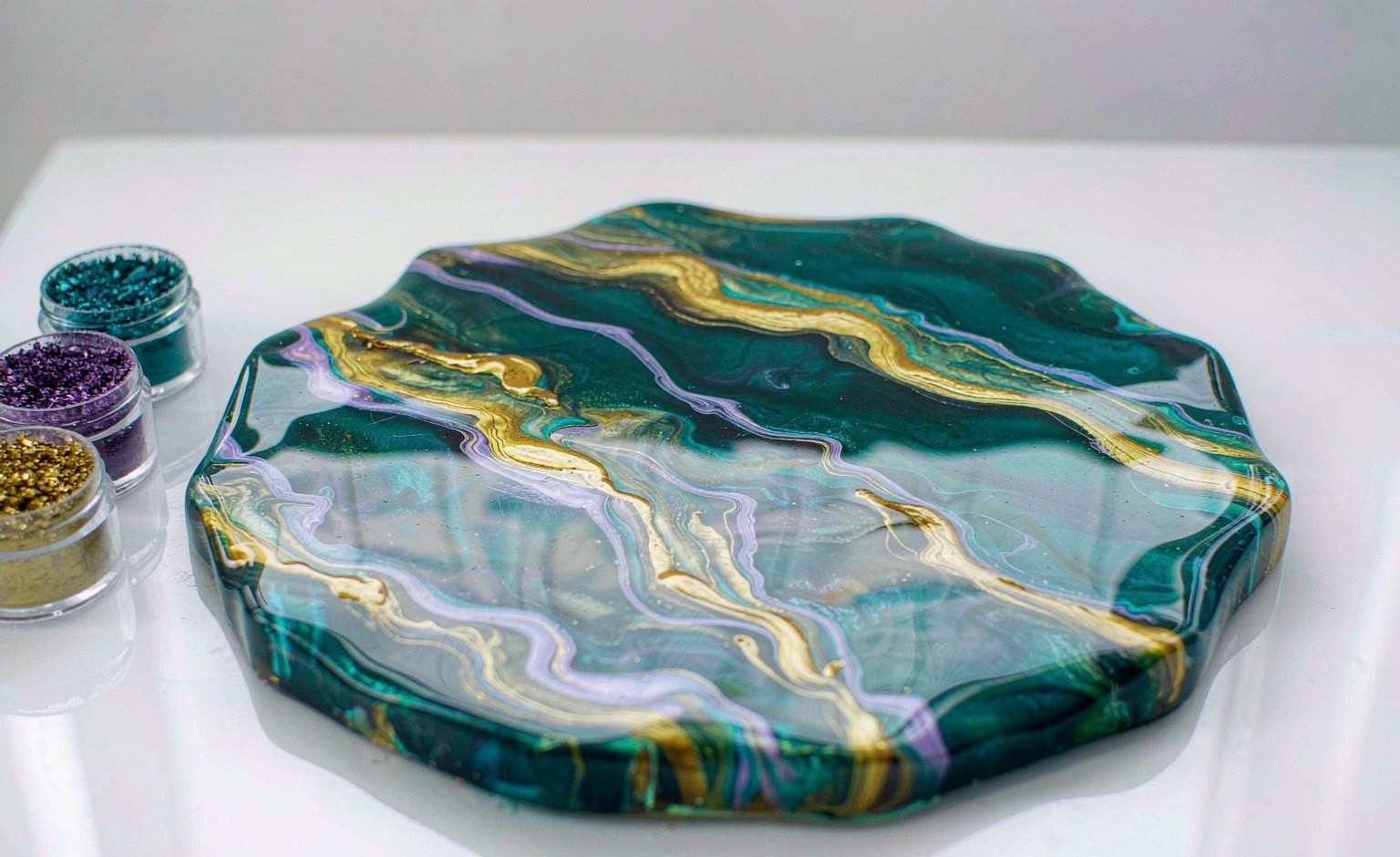
Art-grade mica powder is usually the first effect pigment a maker ever buys — and the one that generates the most "why didn't mine look like the video?" questions. The pigment is rarely at fault. The three variables that decide the outcome are dispersion, viscosity and viewing angle.
Mica powder is hydrophobic and does not wet out easily in viscous resin. The standard fix is a two-step approach: pre-wet the powder in a small amount of a compatible solvent or in a few drops of resin until it forms a smooth paste, then add that paste to the bulk with slow, folded mixing. Mixing powder directly into a full batch is the single most common cause of permanent clumps and "fish eyes".
In thin pours and fluid media, mica plates sink. This is often used deliberately to create "galaxy" effects, but if you need a uniform field you must either raise viscosity (thickeners, matting agents), work in thinner layers, or accept and design around the settling. Note also that orientation follows flow: pouring across a surface tends to align plates horizontally, which maximises reflectivity, while swirling lifts them toward random angles and shifts the piece toward a satin appearance.
In screen printing, the maximum particle size must be substantially smaller than the mesh opening, or particles bridge the mesh and cause streaking and screen blockage. A common working rule is that the largest particle should be no more than roughly one third of the mesh opening — for fine detail work this pushes you toward fine grades and higher mesh counts. In flexo and gravure, the equivalent constraints are the cell depth and the ink viscosity, and coarse sparkle grades can abrade plates on long runs.
Q: Why does my resin piece look duller than the powder in the jar?A: In the jar you see piled powder reflecting from every angle. In the cured piece, plates lie flat and reflect only from the mirror direction. Judge the effect by moving the piece, not by looking straight at it.
Q: Can I use art-grade powder in cosmetics?A: Do not. Art grades are not specified or documented for body contact. Use a cosmetics-grade pigment for skin applications.